Back to Results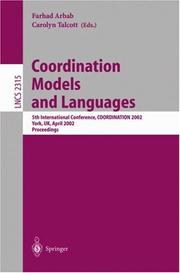
—out of 5—out of 5—out of 5—out of 5—out of 5—out of 5
Magical Tome
- First published
- 2003
- Publisher
- Springer London, Limited
- ISBN
- 9783540460008
Coordination models and languages
The outer archives are busy
About this book
This volume contains the proceedings of the Fifth International Conference on Coordination Models and Languages (Coordination 2002), held in York, UK, 8–11 April 2002. Coordination models and languages close the conceptual gap - tween the cooperation model used by the constituent parts of an application and the lower-level communication model used in its implementation. Coordinati- based methods provide a clean separation between individual software com- nents and their interactions within their overall software organization. This se- ration, together with the higher-level abstractions o?ered by coordination models and languages, improve software productivity, enhance maintainability, advocate modularity, promote reusability, and lead to software organizations and arc- tectures that are more tractable and more amenable to veri?cation and global analysis. Coordination is relevant in design, development, debugging, maintenance, and reuse of all complex concurrent and distributed systems. Speci?cally, - ordination becomes paramount in the context of open systems, systems with mobile entities, and dynamically re-con?gurable evolving systems. Moreover, - ordination models and languages focus on such key issues in Component Based Software Engineering as speci?cation, interaction, and dynamic composition of components.
Match Score
Create a free account to see Match Scores on books the community has marked — once you’ve set your preferences.
Create free accountMarks of the Realm
Marks left by readers of this tome
No community marks yet — be the first to inscribe this tome.
Pacing
Horror / Dark Elements
Romance
Spice Level
LGBTQ+ Representation
Social & Political Themes in Stories