Back to Results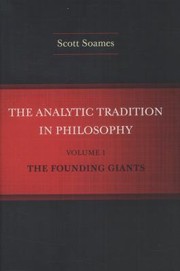
—out of 5—out of 5—out of 5—out of 5—out of 5—out of 5
Magical Tome
- First published
- 2014
- Publisher
- Princeton University Press
- Pages
- 676 pages
- ISBN
- 9781306414289
The Analytic Tradition in Philosophy Volume 1
The outer archives are busy
About this book
This is ... five volumes of a definitive history of analytic philosophy from the invention of modern logic in 1879 to the end of the twentieth century. Scott Soames, a leading philosopher of language and historian of analytic philosophy, provides the fullest and most detailed account of the analytic tradition yet published, one that is unmatched in its chronological range, topics covered, and depth of treatment. Focusing on the major milestones and distinguishing them from the dead ends, Soames gives a seminal account of where the analytic tradition has been and where it appears to be heading. -- from publishers website. Volume 1 examines the initial phase of the analytic tradition through the major contributions of three of its four founding giants—Gottlob Frege, Bertrand Russell, and G. E. Moore. Soames describes and analyzes their work in logic, the philosophy of mathematics, epistemology, metaphysics, ethics, and the philosophy of language. He explains how by about 1920 their efforts had made logic, language, and mathematics central to philosophy in an unprecedented way. But although logic, language, and mathematics were now seen as powerful tools to attain traditional ends, they did not yet define philosophy. As volume 1 comes to a close, that was all about to change with the advent of the fourth founding giant, Ludwig Wittgenstein, and the 1922 English publication of his Tractatus, which ushered in a "linguistic turn" in philosophy that was to last for decades. Volume 2 provides an intensive account of the new vision in analytical philosophy initiated by Ludwig Wittgenstein’s Tractatus Logico-Philosophicus, its assimilation by the Vienna Circle of Moritz Schlick and Rudolf Carnap, and the subsequent flowering of logical empiricism. With this “linguistic turn,” philosophical analysis became philosophy itself, and the discipline’s stated aim was transformed from advancing philosophical theories to formalizing, systematizing, and unifying science. In addition to exploring the successes and failures of philosophers who pursued this vision, the book describes how the philosophically minded logicians Kurt Gödel, Alfred Tarski, Alonzo Church, and Alan Turing discovered the scope and limits of logic and developed the mathematical theory of computation that ushered in the digital era. The book’s account of this pivotal period closes with a searching examination of the struggle to preserve ethical normativity in a scientific age.
Match Score
Create a free account to see Match Scores on books the community has marked — once you’ve set your preferences.
Create free accountMarks of the Realm
Marks left by readers of this tome
No community marks yet — be the first to inscribe this tome.
Pacing
Horror / Dark Elements
Romance
Spice Level
LGBTQ+ Representation
Social & Political Themes in Stories