Back to Results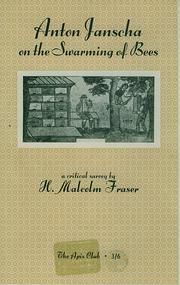
—out of 5—out of 5—out of 5—out of 5—out of 5—out of 5
Magical Tome
- First published
- 1951
- Publisher
- Apis Club
- Pages
- 28 pages
Anton Janscha on the swarming of bees
The outer archives are busy
About this book
INTRODUCTION ACKNOWLEDGEMENT I wish to thank my old school friend Mr. L. R. M. Strachan, M.A., and Mr. N. Reeves, B.Sc, for their help in dealing with Janscha's works and Dr. Eva Crane for her invaluable work in seeing this book through the press. ANTON JANSCHA and the ABHANDLUNG VOM SCHWARMEN DER BIENEN. ALL BEEKEEPERS HAVE HEARD about Huber, the blind Swiss scientist who solved the mystery of the fertilization of the queen bee which had puzzled the world for thousands of years; they also know about his faithful assistant, Francis Burnens, the servant whom he used in place of eyes, and of Mile. Jurine, who, under his direction, discovered the aborted ovaries of the worker bees which had escaped the notice even of the great Swammerdam. Many beekeepers also have read the first and second series of Huber's letters, published in 1792 and 1814 respectively; but the number is small who realize that a poor Carinthian peasant had published—rather more than twenty years before—a full and exact account of the fertilization of the queen bee, and mentioned other reputed discoveries of Huber's. The purpose of this little book is to acquaint its readers with the remarkable attainments of this peasant, Anton Janscha, and to arouse interest in his books. An account of Janscha's life and work follows this introduction so it is only necessary to explain that Janscha wrote two books: Abhandlung vom Schwdrmen der Bienen (A Discourse on the Swarming of Bees) in 1771 and Hinterlassene vollstandige Lehre von der Bienenzucht (A Complete Guide to Beekeeping) in 1775. The former of these is summarized here. The Abhandlung was very well received when it was first issued. The edition of 1771 was (according to Weippl) followed in 1774 by a second from the same Viennese publisher (Joseph Kurzbock) and by a third at Graz in 1775. No others appeared until after the year 1900, for the simple reason that Janscha's larger book, which was published in 1775, superseded it and made further editions unnecessary. Those who read this pamphlet should begin by laying aside their prejudices in favour of the modern movable comb hive. It is not pretended that the Bauernkasten is a better hive than one with movable combs: it certainly is not, but in many respects it is the Langstroth hive's only rival; probably, when piled in beehouses, it is better suited for wintering bees in a cold climate, and it is undoubtedly easier to transport. Janscha's hives, too, had a capacity of about 45 litres; later on, when the peasants desired many swarms to sell in Germany the hive's capacity was reduced
Match Score
Create a free account to see Match Scores on books the community has marked — once you’ve set your preferences.
Create free accountMarks of the Realm
Marks left by readers of this tome
No community marks yet — be the first to inscribe this tome.
Pacing
Horror / Dark Elements
Romance
Spice Level
LGBTQ+ Representation
Social & Political Themes in Stories