Back to Results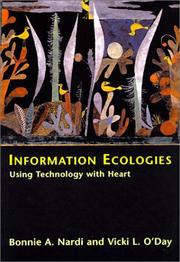
—out of 5—out of 5—out of 5—out of 5—out of 5—out of 5
Magical Tome
- First published
- 1999
- Publisher
- MIT Press
- Pages
- 246 pages
- ISBN
- 9780262324861
Information ecologies
The outer archives are busy
About this book
The common rhetoric about technology falls into two extreme categories: uncritical acceptance or blanket rejection. These two positions leave us with poor choices for action. They encourage us to accept as inevitable whatever technological changes come along. Claiming a middle ground, Bonnie Nardi and Vicki O'Day call for responsible, informed engagement with technology in local settings, which they call *information ecologies.* Their goal is to change the way people look at information technology. An information ecology is a system of people, practices, technologies, and values in a local environment. Like their biological counterparts, information ecologies are diverse, continually evolving, and complex. Nardi and O'Day encourage the reader to become more aware of the ways people and technology are interrelated. A key to thoughtful action, they say, is to ask more "know-why" questions, before jumping to the more straightforward "know-how" questions. They talk about practical ways to have more "know-why" conversations, to dig deeper and reflect more about how we use technology. Nardi and O'Day draw on their empirical research in offices, libraries, schools, and hospitals to show how people can engage their own values and commitments while using technology. These case studies show new and fruitful avenues for participation and engagement with technology. # Table of Contents ## *Part I: Information Ecologies: Concepts and Reflections* **1. Rotwang the Inventor** We look back at Fritz Lang's complex portrait of technology in his classic film *Metropolis*, from 1926. Lang illuminated tensions between head and heart in our human relationship to technology. **2. Framing Conversations about Technology** We discuss the rhetoric of inevitability in which we are constantly told that technical change is inevitable. We consider two faces of this rhetoric: the technophile version which tells us to be happy about the coming changes, and the dystopic view, which sees only doom and gloom. Neither extreme suggests that people who use technology can have a say in what should happen. **3. A Matter of Metaphor: Technology as Tool, Text, System, Ecology** Moving beyond the common rhetorical extremes, we engage more nuanced views, embodied in powerful metaphors: the commonsense but useful view of technology as tool, the subtle postmodern view of technology as text, and the scariest view--of technology as all encompassing system. Ecology is a metaphor too, and we turn to it in the next chapter. **4. Information Ecologies** We discuss information ecologies: sets of people, practices, technologies and values in local settings. An information ecology is a local sphere of influence. Each of us probably belongs to several, including those in our homes, schools, workplaces, and communities. We find common characteristics in biological and information ecologies, including diversity, locality, co-evolution, and keystone species. **5. Values and Technology** As a society, we are vigorously discussing some technology and values issues such as privacy and copyright. But most of the time we don't engage our own values in thinking about how we use technology. We suggest that we try to do this more often, finding inspiration in scholars such as Jacques Ellul, Neil Postman, and Langdon Winner. We urge that we think as hard about "know-why" questions as "know-how" questions, which seem easier for us efficiency-minded people. **6. How to Evolve Information Ecologies** Here's a practical "know-how" for doing the "know-why" questioning, drawing on the work of Fran Peavey, a community activist in California. There's even a Zen poem in this chapter. ## *Part II: Case Studies* **7. Librarians: A Keystone Species** In this chapter, we recount our anthropological studies of reference librarians, some of our favorite people. We discuss the hidden work they do, and we show how they are a "keystone species" in many of today's information ecologies. We feel librarians are more needed than ever as the volume and diversity of information on the Internet grows. **8. Wolf, Batgirl, and Starlight: Finding a Real Community in a Virtual World** "You sit on a beautyful almond colored leather seat." So goes the description of a child's virtual Mustang in an online community Vicki O'Day participated in and studied. This particular online community is an extension of an elementary school in a low-income area of Phoenix, Arizona. The prose the children wrote to communicate with fellow community members is funny, moving, and deeply literate. This chapter highlights two things: co-evolution of online technology and classroom practices, and the application of teaching- and learning-centered values to technology design in the information ecology of the school. **9. Cultivating Gardeners: The Importance of Homegrown Expertise** How do spreadsheets actually get built in office environments? We look at the evolution of "gardeners" or "local experts" who gain expertise in a software system and provide formal or informal help to their coworkers. Gardeners occupy an important ecological niche: they are part customer support and part colleague. As such, they provide targeted, sympathetic help to their fellows in an information ecology, allowing everyone to use technology with less anxiety and more effectiveness. **10. Digital Photography at Lincoln High School** How do we get everyone on board to learn about technology--not just the small cadre of teenage boys who always seem on the ready? One way is not to teach technology, but to teach something a larger, more diverse group is interested in: art. Bonnie Nardi studied a high school digital photography class in a magnet high school in San Jose, California. We describe the diverse makeup of the class and the importance of diversity in the roles of teacher and technology coordinator. **11. A Dysfunctional Ecology: Privacy Issues at a Teaching Hospital** This case study looks at an information ecology in which diverse values centering around privacy came into conflict. We discuss what happened to communication and cooperation when the surgical environment in a teaching hospital was extended through the use of multimedia, as audio and video of ongoing neurosurgical operations were broadcast outside the confines of the operating room. **12. Diversity on the Internet** We believe the protean chaos of the Internet is an international treasure that should be available to all. We provide examples of diversity on the Internet, including its use by Burmese exiles, Inuit women, Maya in Guatemala, Panamanian Indian environmentalists, welfare moms, and even a young, white, American male. We hope for universal access to the Internet for those who want it, regardless of income, analogous to the "universal lifeline" phone service available to low-income people in the U.S. **13. Conclusion** We argue for deeper reflection on how we use technologies in our information ecologies. # Online access chapters The first few chapters are freely available online: - ["Table of contents"](https://firstmonday.org/ojs/index.php/fm/article/view/668/578). *First Monday*. **4** (5). 3 May 1999. doi:[10.5210/fm.v4i5.668](https://doi.org/10.5210%2Ffm.v4i5.668). - ["Preface"](https://firstmonday.org/ojs/index.php/fm/article/view/669/579). *First Monday*. **4** (5). 3 May 1999. doi:[10.5210/fm.v4i5.669](https://doi.org/10.5210%2Ffm.v4i5.669). - ["Chapter One: Rotwang the inventor"](https://firstmonday.org/ojs/index.php/fm/article/view/670/580). *First Monday*. **4** (5). 3 May 1999. doi:[10.5210/fm.v4i5.670](https://doi.org/10.5210%2Ffm.v4i5.670). - ["Chapter Two: Framing conversations about technology"](https://firstmonday.org/ojs/index.php/fm/article/view/671/581). *First Monday*. **4** (5). 3 May 1999. doi:[10.5210/fm.v4i5.671](https://doi.org/10.5210%2Ffm.v4i5.671). - ["Chapter Three: A matter of metaphor: Technology as tool, text, system, ecology"](https://williamwolff.org/wp-content/uploads/2008/01/nardi-ecologies-1999.pdf) (PDF). *Information ecologies: Using technology with heart*. Cambridge, Massachusetts: MIT Press. February 1999. pp. 25–47. ISBN 978-0-262-14066-9. - ["Chapter Four: Information ecologies"](https://firstmonday.org/ojs/index.php/fm/article/view/672/582). *First Monday*. **4** (5). 3 May 1999. doi:[10.5210/fm.v4i5.672](https://doi.org/10.5210%2Ffm.v4i5.672). - ["Chapter Four: Information ecologies"](https://williamwolff.org/wp-content/uploads/2008/01/nardi-metaphor-1999.pdf) (PDF). *Information ecologies: Using technology with heart*. Cambridge, Massachusetts: MIT Press. February 1999. pp. 49–58. ISBN 978-0-262-14066-9.
Match Score
Create a free account to see Match Scores on books the community has marked — once you’ve set your preferences.
Create free accountMarks of the Realm
Marks left by readers of this tome
No community marks yet — be the first to inscribe this tome.
Pacing
Horror / Dark Elements
Romance
Spice Level
LGBTQ+ Representation
Social & Political Themes in Stories