Back to Results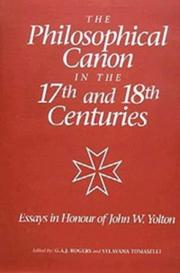
—out of 5—out of 5—out of 5—out of 5—out of 5—out of 5
Magical Tome
- First published
- 1996
- Publisher
- University of Rochester Press
- Pages
- 232 pages
- ISBN
- 9781878822642
Philosophical Canon in the Seventeenth and Eighteenth Centuries
The outer archives are busy
About this book
This collection of essays by distinguished and well known scholars working in the history of philosophy and intellectual history, illustrates many of John Yolton's central interests. The contributors represent the four countries with which John Yolton has been most closely associated: Canada, France, Great Britain and the United States. Francois Duchesneau begins with a topic to which Yolton has made a special contribution, Locke and the idea of thinking matter. The epistemological dimension which he gives to this topic is one taken up in Richard Popkin's analysis of scepticism and reason in the seventeenth and eighteenth centuries, and it is the place of scepticism in Locke's thought that G. A. J. Rogers discusses in his paper. In his account of the recovery of Locke's library, Peter Laslett tells a story that every scholar would be well advised to mark and read with pleasure. Michael Ayers examines Locke's understanding of Laws of Nature and their implications. His account also touches on Berkeley's philosophy. And it is both Locke and Berkeley, and their conceptions of common sense, that is the subject of Genevieve Brykman's paper. The two philosophers feature in M. A. Stewart's examination of "abstract ideas," which he also applies to Hume. Arthur Wainwright explores the connection between reason and revelation in some early eighteenth-century writers, and John Stephens gives us insight into the teaching of philosophy in the early eighteenth-century at Cambridge. John P. Wright engages in a debate with Yolton's account of Hume's theory of perception and links it with a discussion of Descartes's theory. In the last essay Shadia B. Drury attacks the postmodernist crude representation of the Enlightenment. Her objective is one which Yolton would surely endorse.
Match Score
Create a free account to see Match Scores on books the community has marked — once you’ve set your preferences.
Create free accountMarks of the Realm
Marks left by readers of this tome
No community marks yet — be the first to inscribe this tome.
Pacing
Horror / Dark Elements
Romance
Spice Level
LGBTQ+ Representation
Social & Political Themes in Stories