Back to Results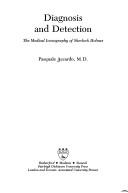
—out of 5—out of 5—out of 5—out of 5—out of 5—out of 5
Magical Tome
- First published
- 1987
- Publisher
- Fairleigh Dickinson University Press
- Pages
- 139 pages
- ISBN
- 0838632920
Diagnosis and detection
The outer archives are busy
About this book
> In *Diagnosis and Detection*, Pasquale Accardo has determined to rescue Holmes and Watson from the historicism, psychologism, and armchair pseudo-analysis in which they have become entangled and to place them squarely in the company of the greatest creations of the Western literary imagination. In medicine and history, and in literature and myth, the author searches out and explores the archetypes that have contributed to the great detective's universal appeal. Sherlock Holmes is revealed to be an adversarial hero of the first magnitude, and a countercultural champion of intuition and insight, vision and discovery. >Although much Sherlockian scholarship has tried to elaborate the historic background and symbolic meaning of the Holmes canon, it has relegated the articulation of the mythic substructure of the works to random oblique comments or occasional footnotes. Sherlock Holmes is routinely presented as a symbol of the rational approach to problem solving. However, Accardo finds that symbol and myth are frequently at cross purposes, with the symbol representing a later attempt to rationalize away the primitive mythic content. >Earlier critical assessments of Sherlock Holmes's diagnostic skills have all assumed them to be correct in principle. But Accardo reveals Holmes's methods to be based on a misinterpretation of medical diagnostics and uncovers the intuitive truths that made the famous sleuth's exaggerated claims work. Focusing on Holmes's alter ego, Watson, the author shows that the good doctor reflects the relatively greater importance of compassion over technical competence in the practice of detection/medicine. >This study pays particular attention to the many literary and historical prototypes of the Holmes character - from the detectives created by Edgar Allan Poe to some surprising parallels in other works, including heroes of epic and medieval romances; Dumas's D'Artagnan; Shakespeare's Hamlet, Prince Hal, and Falstaff; Lewis Carroll's Alice; and earlier Eastern literary examples. Among Arthur Conan Doyle's contemporaries, one writer is considered at length: G. K. Chesterton's Father Brown was conceived as both a homage to and a criticism of the myth of the "great detective." The author also analyzes a later work that may be recognized as the only post-Doyle contribution to add significantly to the Holmes literary legacy - James Goldman's *They Might Be Giants*. An appendix presents the first quantitative stylistic analysis of the Holmes canon.
Match Score
Create a free account to see Match Scores on books the community has marked — once you’ve set your preferences.
Create free accountMarks of the Realm
Marks left by readers of this tome
No community marks yet — be the first to inscribe this tome.
Pacing
Horror / Dark Elements
Romance
Spice Level
LGBTQ+ Representation
Social & Political Themes in Stories