Back to Results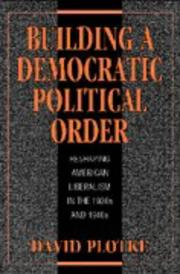
—out of 5—out of 5—out of 5—out of 5—out of 5—out of 5
Magical Tome
- First published
- 1996
- Publisher
- Cambridge University Press
- ISBN
- 9780511881459
Building a Democratic Political Order
The outer archives are busy
About this book
The Democratic political order in the United States defined the main themes, policies, and organized forms of national politics from the 1930s through the 1960s. David Plotke explores the dramatic changes in American politics that occurred during the 1930s and 1940s. In these decades an expanded federal government and a new labor movement emerged as Republican power waned. World War II and the Cold War reshaped the Democratic order without ending it. And national political debate about civil rights was opened. The central dynamic of this era was the creation and maintenance of a distinctive new political order, built by progressive liberals in alliance with mass movements, notably labor. At its core was a powerful triangle formed by a national state, a leading party, and major interest groups and movements. Democratic and modernizing themes fused together in a progressive liberalism that advocated government action to achieve economic stability, protect social security, and expand political representation. In building the Democratic order the expansion of the national state played a crucial role - and the eventual decline of Democratic power was due in large part to its reliance on that state. Far from being nonideological, the Democratic order defined itself in sharp conflicts with forces on its right and left. Democratic progressive liberalism recast American political institutions and discourses in ways that went well beyond what was foreseen in the early 1930s, and in forms strong enough to endure long after Roosevelt's death.
Match Score
Create a free account to see Match Scores on books the community has marked — once you’ve set your preferences.
Create free accountMarks of the Realm
Marks left by readers of this tome
No community marks yet — be the first to inscribe this tome.
Pacing
Horror / Dark Elements
Romance
Spice Level
LGBTQ+ Representation
Social & Political Themes in Stories