Back to Results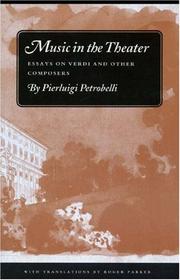
—out of 5—out of 5—out of 5—out of 5—out of 5—out of 5
Magical Tome
- First published
- 2016
- Publisher
- Princeton University Press
- Pages
- 204 pages
- ISBN
- 9780691632797
Music in the theater
The outer archives are busy
About this book
Well known for having generated new interest in Verdi as a subtle and elaborate musical thinker, Pierluigi Petrobelli offers here lively, penetrating explanations of how music in the theater works: Why is it that only a few operas constitute the standard repertory of all opera houses throughout the world, to the constant delight of their audiences? What makes these operas as effective today as they were at the time of their creation? Is there a governing principle in their organization and structure? In this collection of essays, most of which appear in English for the first time, Petrobelli answers these questions by presenting historical facts and analyzing specific operas, mainly by Verdi, in terms of musical organization and dramaturgical conventions. From the exploration of clearly detectable stylistic models - Rossini's Mose for Verdi's Nabucco, and the first act finale of Don Giovanni for the opening scene of Rigoletto - the essays move to the study of Verdi's compositional process as revealed by the sketches for Alzira, I due Foscari, and Rigoletto. Unifying musical devices are discussed in essays on Il trovatore and Macbeth. Using Aida and La forvza del destino, Petrobelli builds toward a theory based on three elements of communication within opera: the dramatic structure, the libretto and its metrical arrangement, and the score. The volume culminates with the application of these analytic tools to the opening of Gluck's Alceste and the making of Bellini's I puritani.
Match Score
Create a free account to see Match Scores on books the community has marked — once you’ve set your preferences.
Create free accountMarks of the Realm
Marks left by readers of this tome
No community marks yet — be the first to inscribe this tome.
Pacing
Horror / Dark Elements
Romance
Spice Level
LGBTQ+ Representation
Social & Political Themes in Stories