Back to Results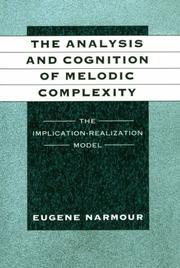
—out of 5—out of 5—out of 5—out of 5—out of 5—out of 5
Magical Tome
- First published
- 1992
- Publisher
- University of Chicago Press
- Pages
- 431 pages
- ISBN
- 0226568423
The analysis and cognition of melodic complexity
The outer archives are busy
About this book
In this work, Eugene Narmour extends the unique theories of musical perception presented in The Analysis and Cognition of Basic Melodic Structures. The two books together constitute the first comprehensive theory of melody founded on psychological research. Narmour's earlier study dealt with cognitive relations between melodic tones at their most basic level. After summarizing the formalized methodology of the theory described in that work, Narmour develops an elaborate and original symbology to show how sixteen archetypes can combine to form some 200 complex structures that, in turn, can chain together in a theoretically infinite number of ways. He then explains and speculates on the cognitive operations by which listeners assimilate and ultimately encode these complex melodic structures. More than 250 musical examples from different historical periods and non-Western cultures demonstrate the panstylistic scope of Narmour's model. Of particular importance to music theorists and music historians is Narmour's argument that melodic analysis and formal analysis, though often treated separately, are in fact indissolubly linked. The Analysis and Cognition of Melodic Complexity will also appeal to ethnomusicologists, psychologists, and cognitive scientists.
Match Score
Create a free account to see Match Scores on books the community has marked — once you’ve set your preferences.
Create free accountMarks of the Realm
Marks left by readers of this tome
No community marks yet — be the first to inscribe this tome.
Pacing
Horror / Dark Elements
Romance
Spice Level
LGBTQ+ Representation
Social & Political Themes in Stories