Back to Results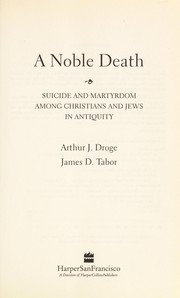
—out of 5—out of 5—out of 5—out of 5—out of 5—out of 5
Magical Tome
- First published
- 1992
- Publisher
- HarperSanFrancisco
- Pages
- 203 pages
- ISBN
- 0060620951
A noble death
The outer archives are busy
About this book
The right to die with dignity has emerged as a crucial issue in the 1990s. As reports of family- or doctor-assisted suicides increase, the issue of voluntary death is occupying an increasingly prominent place in our national consciousness. From theologians, medical ethicists, and talk-show hosts to people facing the issue in their own lives, all are participants in the debate, each seeking to influence and control the discourse on suicide and euthanasia. Now, this. Pathbreaking study provides a stunning reappraisal of the early history of this controversial human freedom. A Noble Death challenges the often unquestioning attitudes we have toward suicide and traces the evolution of these attitudes from the time of Socrates to the present day. Droge and Tabor reveal the extraordinary fact that early Christians and Jews did not absolutely condemn suicide, but instead focused on whether or not it was committed for noble reasons. In. Fascinating detail, the texts and traditions presented here--from Greek and Roman philosophy, to Judaism, Christianity, and the Bible itself--make clear that the decision to take one's life, or allow it to be taken, was not considered a sin but a noble choice, provided there was sufficient justification for the act. "The Bible nowhere proscribes suicide," the authors write. "In fact, there are at least seven individuals in the Bible who take their own lives, and none of. Them is condemned for the act ... Many [have] a vague notion that the so-called Judeo-Christian tradition speaks decisively against the act of suicide, but just what that objection is, when it developed, and what came before it, are mostly not known." From Socrates' insistence on the requirement of a divine sign to Seneca's emphasis on the unqualified freedom of the individual to Augustine's attempt to restrict that freedom, A Noble Death illustrates how strongly we. Share these early attitudes toward voluntary death. But the very attempt to find a consensus indicates how the decision to die could--and can--be a conscientious one. Intensely relevant to the contemporary debate, A Noble Death takes the reader on a challenging and instructive journey to the surprising origins of Western culture's thoughts on voluntary death.
Match Score
Create a free account to see Match Scores on books the community has marked — once you’ve set your preferences.
Create free accountMarks of the Realm
Marks left by readers of this tome
No community marks yet — be the first to inscribe this tome.
Pacing
Horror / Dark Elements
Romance
Spice Level
LGBTQ+ Representation
Social & Political Themes in Stories