Back to Results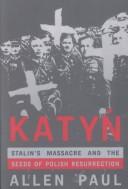
—out of 5—out of 5—out of 5—out of 5—out of 5—out of 5
Magical Tome
- First published
- 1996
- Publisher
- Naval Institute Press
- Pages
- 402 pages
- ISBN
- 1557506701
Katyń
The outer archives are busy
About this book
In April 1943, the Germans announced some grisly news: near Smolensk they had discovered the corpses of thousands of Polish army officers whose last known custodians had been Soviet guards as a result of the partition of Poland in 1939. The pots called the kettles black, though there was little doubt then--and none now that the Soviets recently apologized for the crime--that Stalin authorized the mass murder. Why he did remains conjectural, but the odium attached to his German accuser furnished him the pretext to impose his preferred government and borders on postwar Poland. Although Paul alludes to these pivotal diplomatic consequences of the incident, his book mainly concentrates on proving the forensic case that the N.K.V.D., not the Gestapo, was indeed responsible. He further etches the human impact of the crime by interviewing relatives of the victims, and evenhandedly discusses the hands-off British and American reaction to their ally's discomfiture. Soaking up these details takes perseverance and a strong stomach, but here's another sordid memorial to Stalin's rule. Fascinating and heartrending history of the USSR's mass murder of over a million Poles during World War II. Stalin carried out a deadly deportation of an estimated 1.2 million middle class Poles from Soviet-occupied eastern Poland, targeting teachers lawyers, shopkeepers, doctors (including several hundred thousand Jews) and shipped them in boxcars to Siberia. Only a fraction survived the journey and subsequent exposure, forced labor, and starvation. In addition, the Soviets slaughtered over 15,000 Polish officers and noncoms in the Katyn Forest. This carefully done book brings this once hidden story to life in compelling and effective detail. Powerful examination of Stalin's infamous WW II campaign against Poland's professional and middle classes, exemplified by the 1940 execution (denied by the Soviets until 1990) of most of Poland's officer corps in the Katy Forest and at still-unknown sites. The Katy Forest massacre, in which 15,000 Polish officers held by the Bolsheviks were shot by the NKVD, has become the ``complex symbol of Polish suffering at the hands of Stalin,'' argues Paul, who began his research at the Center for European Studies in Bologna, Italy, under the auspices of Johns Hopkins Univ. School of Advanced International Studies. Using US Congressional testimony released only in 1989, buttressed by extensive interviews with survivors, Paul claims to present the most definitive view to date of Katy, blending historical reportage with narratives of three families caught up in Stalin's crimes. Indeed, for 50 years the story was buried not only by the Soviets but by Western governments, which concealed knowledge of Soviet guilt to protect their relationships with the USSR. Paul presents evidence of Stalin's one-word written order, ``Liquidate,'' which led to the murders, then details Soviet attempts to deny knowledge of the atrocity and, later, to blame the Nazis for it (after the Germans discovered some of the mass graves, the Nazis sought to propagandize the crime in order to divide the Allies). According to Paul, Stalin even manipulated the discovery ``to deal the legitimate government of Poland a lethal blow'' and set up a puppet regime. Moreover, Paul says, during the war years, the Soviets deported to Siberia and other harsh climes more than a million middle-class Poles, many of whom ``perished from starvation, forced labor and neglect.'' Well researched and ably written: a fine and harrowing study.
Match Score
Create a free account to see Match Scores on books the community has marked — once you’ve set your preferences.
Create free accountMarks of the Realm
Marks left by readers of this tome
No community marks yet — be the first to inscribe this tome.
Pacing
Horror / Dark Elements
Romance
Spice Level
LGBTQ+ Representation
Social & Political Themes in Stories