Back to Results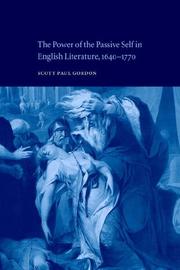
—out of 5—out of 5—out of 5—out of 5—out of 5—out of 5
Magical Tome
- First published
- 2005
- Publisher
- Cambridge University Press
- Pages
- 291 pages
- ISBN
- 9780521021845
The Power of the Passive Self in English Literature, 16401770
The outer archives are busy
About this book
"Challenging recent work that contends that seventeenth-century English discourses privilege the notion of a self-enclosed, self-sufficient individual, The Power of the Passive Self in English Literature recovers a counter-tradition that imagines selves as more passively prompted than actively choosing. This tradition - which Scott Paul Gordon locates in seventeenth-century religious discourse, in early eighteenth-century moral philosophy, in mid eighteenth-century acting theory, and in the emergent novel - resists autonomy and defers agency from the individual to an external "prompter." Gordon argues that the trope of passivity aims to guarantee a disinterested self in a culture that was increasingly convinced that every deliberate action involves calculating one's own interest. Gordon traces the origins of such ideas from their roots in the nonconformist religious tradition to their flowering in one of the central texts of eighteenth-century literature, Samuel Richardson's Clarissa."--BOOK JACKET.
Match Score
Create a free account to see Match Scores on books the community has marked — once you’ve set your preferences.
Create free accountMarks of the Realm
Marks left by readers of this tome
No community marks yet — be the first to inscribe this tome.
Pacing
Horror / Dark Elements
Romance
Spice Level
LGBTQ+ Representation
Social & Political Themes in Stories